Guiding Your Child Through Exam Stress: Practical Strategies for Well-Being and Success
Guiding Your Child Through Exam Stress: Practical Strategies for Well-Being and Success
They’re sitting there. The book is open. Nothing’s happening. You know that moment.
They’re at the table, everything looks right from the outside, and somehow nothing is happening. The book is open, the pen is there, they’ll tell you they’ve started, and you want to believe them because technically they probably have, but nothing is really moving in a way that gets them anywhere. You leave it for a bit because you don’t want to hover.
When you come back, there’s something on the page, but it doesn’t hold together. A few lines, something crossed out, a question that never quite gets finished. You suggest they keep going, because that’s what you would do.
That’s where it begins to slip.
It’s not a big reaction. It rarely is at first. Something just tightens. The answer you get back is shorter, or sharper, or it doesn’t come at all. Sometimes they go quiet in a way that feels like they’ve already checked out.
From where you’re standing, it can look like they’re refusing.
From where they’re sitting, it doesn’t feel like that.
It took me a while to realise it isn’t really about the work, at least not at that point. By the time they sit down, they’ve already used up a lot of what they normally rely on to get started. The whole day sits behind that moment.
The effort of keeping up, switching, adjusting, holding things together.
So when you ask for focus, you’re asking for something that isn’t fully there anymore.
And then we add pressure, because we have to. The work still needs to be done.
I used to push through that moment. Just keep going. Just do the next part. Just focus. It sounds reasonable.
It just makes everything smaller and tighter.
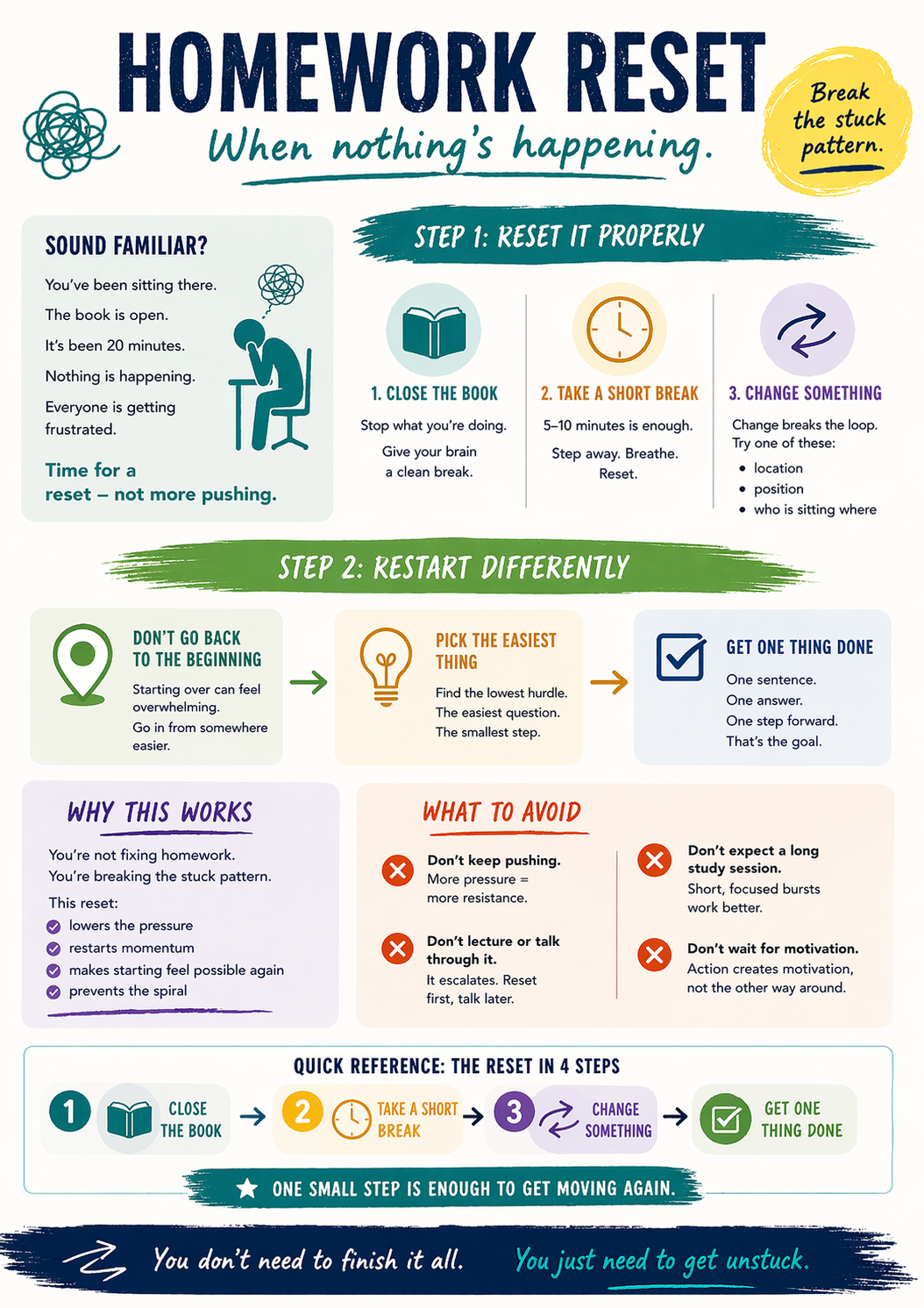
What I do now is close the book. Not as a reaction. Just to take it out of the situation for a minute. If I leave it open, we sit there circling the same point. So I’d rather interrupt it early than let it drag on. I’ll send him outside, or tell him to move, or get him to do something that has nothing to do with sitting still and thinking. Sometimes he resists it. Sometimes he doesn’t. Sometimes he comes back and it still feels stuck. But often there’s enough of a shift to try again. When he sits down again, I don’t go back to the start. That’s usually where it stalled.
I pick something small. “Tell me what this is about.” “What do you think they’re asking here?” “Start anywhere.”
Something that doesn’t require him to hold the whole thing in his head at once. Sometimes it turns into a conversation that wanders a bit. It doesn’t look tidy. It doesn’t look efficient. I have to stop myself from pulling it back too quickly. Because that’s usually where something clicks. And once there’s a way in, even a small one, he can keep going for a bit on his own.
I don’t aim for long stretches anymore. If he gets through something properly, we stop.
That’s the point where it still feels doable. If we keep pushing past that, it tends to fall apart again and we’re back at the beginning.
Some days that works. Other days it doesn’t go anywhere, and we’ve spent the time without getting much for it.
Those are the days that test you. Because everything in you wants to step in harder, say more, fix it. And that’s usually the point where it starts to go wrong again. If you watch closely, there’s a moment before it tips. It’s easy to miss if you’re focused on the task. The way they’re sitting changes. The rhythm goes. Something speeds up or shuts down. If I catch it there, I can usually shift things a bit.
If I don’t, we’re dealing with what comes after.
I don’t think exams create this. They just make it harder to ignore. And I still get it wrong a lot.